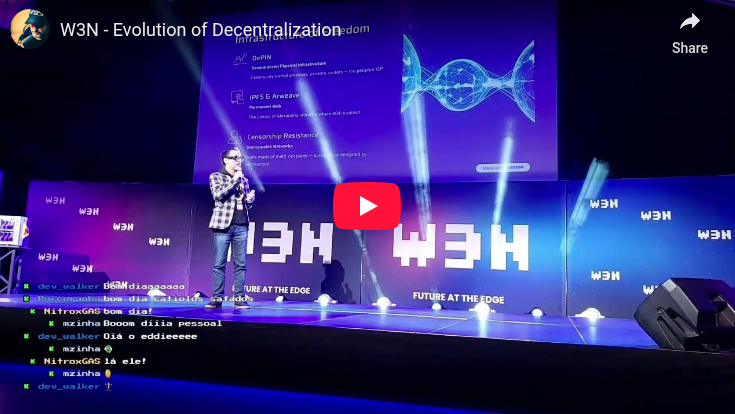
Evolution of Decentralization
History is traditionally attributed to the victors, but its true course is charted by the architects.

History is traditionally attributed to the victors, but its true course is charted by the architects.
For centuries, "decentralization" was little more than a philosophical whisper - a recurring dream shared by 18th-century French radicals and American Anti-Federalists. They sought a world where power was distributed, yet in practice, gravity always favored the center. Kings evolved into corporations; town squares were replaced by proprietary data silos. We possessed the political will for freedom, but we lacked the technical rails to sustain it.
We are now witnessing the most significant migration in human history: the transition from the era of "Don't be Evil" (relying on the promises of centralized gatekeepers) to the era of "Can't be Evil" (relying on the immutable laws of mathematics).
The Ancestry of Code: From Manifestos to Protocols
The foundation of our digital reality was laid in the 1990s by the Cypherpunks. Eric Hughes, Timothy May, and Hal Finney recognized a fundamental truth: in an electronic age, privacy is the prerequisite for an open society. They didn't just write manifestos; they wrote the code for sovereignty.
In 2009, Satoshi Nakamoto triggered the "Big Bang" of decentralized infrastructure. Bitcoin was the first proof that humanity could coordinate globally and trustlessly without a central intermediary. Later, Ethereum expanded this logic - if Bitcoin decentralized the ledger, Ethereum decentralized the logic of the law itself through smart contracts.
The Four Phases of Decentralization
| Phase | Paradigm | The Breakthrough |
| Phase 1 | Ideology | Cypherpunks establishing the philosophical right to privacy. |
| Phase 2 | Currency | Bitcoin: The decoupling of money from the state. |
| Phase 3 | Computation | Ethereum: Turning code into immutable law via smart contracts. |
| Phase 4 | Civilization | The Sovereign Stack: Rebuilding identity, storage, and governance. |
Digital Dignity: Identity as a Shield
For two decades, we have lived as "digital sharecroppers," tilling the fields of Meta, Google, and X. We generate the data, but they own the land. In this model, if a platform de-platforms you, your digital existence is effectively erased.
This ends with Decentralized Identifiers (DIDs) and Self-Sovereign Identity (SSI). This is not a buzzword; it is a shield.
- True Ownership: Your identity is no longer a row in a corporate database; it is a cryptographic key in your pocket.
- Selective Disclosure: You can prove you are over 21, a citizen, or solvent without revealing the underlying sensitive data.
- Reputational Portability: You own your history, your connections, and your social graph. This is the return of dignity to the digital age.
Hardening the Web: DePIN and Permanent Storage
To mitigate mass surveillance, we must build architecture where the walls are made of math, not paper. We are currently seeing the rise of Decentralized Physical Infrastructure Networks (DePIN) - community-owned networks of antennas, sensors, and routers that provide internet services independent of state or corporate control.
Furthermore, protocols like IPFS and Arweave are creating a "Permanent Library of Alexandria." On this distributed web, the "404 Not Found" error becomes a relic of the past. Information becomes resilient, censorship-resistant, and permanent.
DAOs: Governance at the Speed of Light
We are witnessing the birth of a new institutional foundation: the DAO (Decentralized Autonomous Organization). These are the native governance layers of the internet - fluid, transparent, and borderless.
- Service DAOs are replacing legacy agencies.
- Investment DAOs are democratizing venture capital.
- Impact DAOs are replacing inefficient NGOs, allowing global collectives to pool resources for conservation (e.g., buying land) governed by code rather than distant boards of directors.
In a DAO, transparency is the default and corruption is a bug. They allow us to coordinate human potential on a scale never before seen.
Beyond the "Casino": The Utility of Web3
Skeptics often dismiss this movement as a "DeFi casino." But to focus only on the speculation is to ignore the rocket ship because the engine is loud. The "state-of-the-art" in Web3 is already transforming reality:
- DeSci (Decentralized Science): Research for rare diseases is being funded by tokenized communities, allowing patients and scientists -not Big Pharma - to own the intellectual property.
- DeSoc (Decentralized Social): Platforms like Farcaster and Nostr prove you can have a social graph that you own. If an app becomes toxic, you simply move your data to a better interface.
- ReFi (Regenerative Finance): Programmable money is being used to back currency with natural capital, making carbon credits verifiable and rewarding those who restore the planet.
The Architect’s Mandate
Infrastructure is neutral; it can be a tool for liberation or a mechanism for total control. The tools we build today -Zero-Knowledge Proofs, DIDs, and DAOs - will serve as the constitution for the next century of human freedom.
We must stop building for speculation and start building for sovereignty. We must build for the user who lives where speaking the truth is a crime. Decentralization is no longer a theory for dinner parties; it is the concrete, steel, and fiber of a free world.
Let’s go build it.
Verify. Don't Trust.